
Executive view
The direction and the speed are different questions.
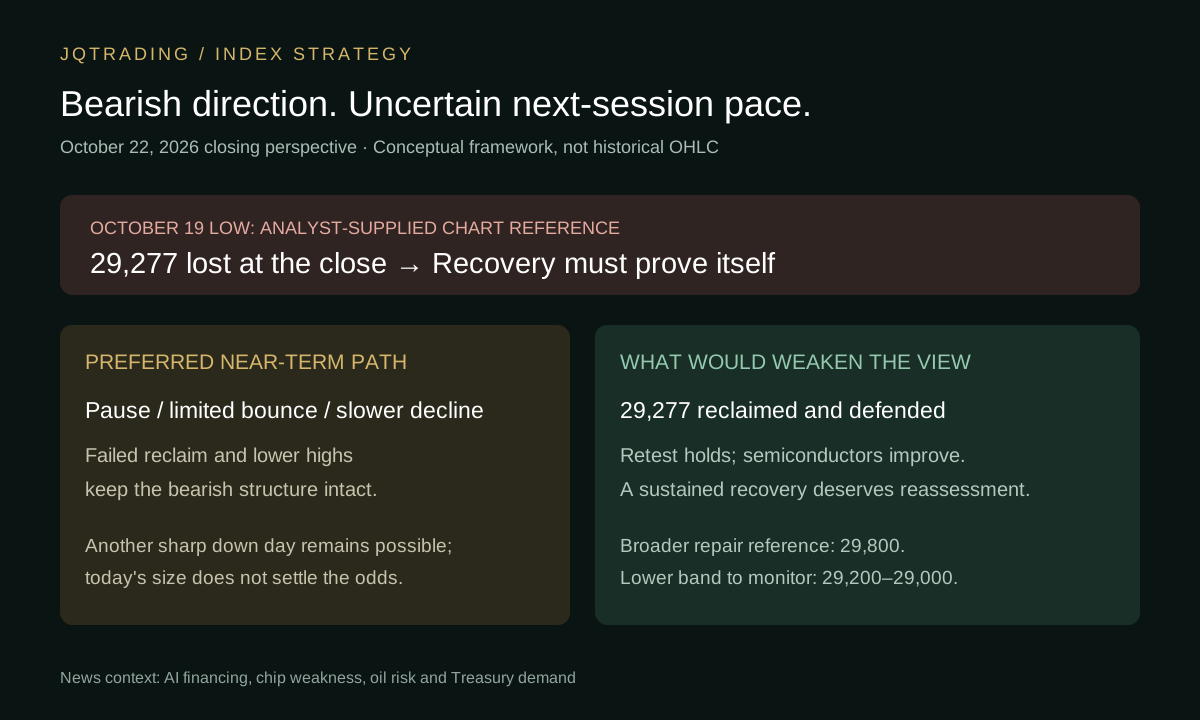
NQ has closed below 29,277, the October 19 low on the analyst's reference chart. We read that as another support failure and evidence that the recent recovery is losing traction. Our working view is that a renewed downward leg is beginning, with downside more likely than a sustained advance over the near term.
October 22 has already delivered a substantial decline. We would not make an equally large fall on the next trading day our base case. A pause, a modest recovery or a more gradual decline looks more plausible to us. That assessment does not make a major rebound our preferred outcome, and it does not mean downside risk has disappeared.
Technical structure
29,277 becomes the immediate recovery test.
A prior daily low provides a visible reference for buyers defending a recovery. Closing beneath it suggests that demand did not hold at the point where the rebound needed support. That makes the quality of any attempted reclaim more important than the fact that price may bounce intraday.
If NQ remains below 29,277 or briefly recovers it before falling back, the breakdown continues to favor sellers. If buyers reclaim it, hold it through the close and defend a retest, our immediate bearish conviction should weaken. A single close below support is evidence of deterioration, not proof that every lower level will necessarily fail.
Our October 21 reassessment made the recovery conditional on holding 29,800 and avoiding a rapid reversal. The latest support loss reinforces the concern that the recovery may have failed. But 29,277 is above the lower edge of the separate 29,200–29,000 band: losing it does not, by itself, establish that the entire lower band has been lost.
News available on October 22
The pressure is concentrated in the Nasdaq's leadership.
Reuters reported selling across AI-related shares as investors focused on the cost and financing of the infrastructure buildout. Meta's plan to create another class of shares to help raise funds added to that debate, while Lam Research's results also weighed on semiconductor sentiment. [1]
Reuters' same-day market review reported a 6.7% fall in the Philadelphia Semiconductor Index, a jump in oil and a sharp decline in U.S. Treasury yields as investors sought safety. [2] Our interpretation is that weaker technology leadership and financing sensitivity help explain why an NQ support failure deserves attention; the news does not establish a precise futures target or tomorrow's return.
AP reported that the Nasdaq Composite fell 2.6% and the S&P 500 fell 1.2%, while the Dow edged higher and most S&P 500 stocks rose. Brent climbed 4% to $113.17 amid Iran-war concerns. [3] The cash-index figures are context, not NQ futures returns.
| Contemporaneous evidence | Our interpretation | What it does not establish |
|---|---|---|
| AI funding concerns and weak semiconductor shares [1][2] | A recovery needs its leading technology groups to regain support; otherwise rebounds may struggle. | Not proof that AI demand has disappeared or that a collapse is inevitable. |
| Higher oil amid geopolitical uncertainty [2][3] | Energy risk can complicate the inflation and growth outlook and discourage risk-taking. | No assumption about future conflict developments or oil prices. |
| U.S. Treasury yields fell in the selloff [2] | Lower yields can accompany risk aversion; they are not automatically a bullish signal for NQ. | The session should not be explained as an equity decline caused by rising U.S. yields. |
| Weak headline indexes alongside firmer broad participation [3] | Concentration makes this particularly relevant to technology-heavy exposure. | Not evidence that every U.S. stock or sector was in a synchronized collapse. |
The next-session question
A large decline can be followed by a pause without repairing the trend.
After a sharp down session, some selling may already have been brought forward. Short covering and bargain buying could produce a quieter session or a temporary rebound. These are reasons to avoid extrapolating the latest decline in a straight line, not evidence that the market has reached a durable low.
Our preferred path is a less violent continuation: consolidation, unsuccessful recovery attempts and lower highs that gradually give way to fresh lows. We do not favor a major sustained rally without a successful reclaim of broken support and improving technology participation.
The size of today's move alone cannot tell us the probability of another large down day. A severe follow-through decline remains possible. Our view that a slower path is more plausible is a qualitative forecast, not a statistically tested rule or a reason to assume a quiet next session.
Levels and scenarios
Require confirmation at each step.
| Path | What to watch | Implication |
|---|---|---|
| Preferred: slower downside | NQ pauses or rebounds modestly, cannot hold a reclaim of 29,277 and develops lower highs. | The bearish trend persists even if the next daily decline is smaller. |
| Downside acceleration | Persistent selling and failure to hold or recover the 29,200–29,000 band. | The larger downside scenario strengthens; the prior 27,200 reference becomes relevant conditionally. |
| Near-term repair | A sustained reclaim of 29,277, a defended retest and better semiconductor participation. | Reduce conviction in immediate continuation; reassess the recovery. |
| Broader recovery | Price subsequently recovers and holds the earlier 29,800 resistance area. | Stronger evidence against the larger bearish thesis. |
We do not infer the precise October 22 settlement or the status of every lower level from the statement that NQ closed below 29,277. The 27,200 reference comes from the earlier conditional framework; it is not an unconditional next-session target.
Our stance
We favor downside, with room for interruptions.
The support failure and the contemporaneous pressure on technology leadership reinforce our bearish view. In our assessment, near-term downside is more plausible than a sustained advance, but an immediate repeat of the latest sharp decline is not the path we favor most.
A limited bounce would not by itself change that view. We need a recovery that holds above broken support, survives a retest and gains sector participation. Until those conditions appear, we favor a downward trend that may unfold through pauses and smaller declines rather than an uninterrupted plunge. We will revise the assessment if price repairs the structure.
Sources
Contemporaneous reporting; a separate technical judgment.
- Reuters, October 22: Steep bill for AI buildout punishes Meta, other tech favorites. Same-day reporting; intraday share moves are not used as exact closing prices.
- Reuters / Jamie McGeever, October 22: Trading Day — Maximum pAIn. A same-day market review and commentary.
- Associated Press / Stan Choe, October 22: Sharp drops for AI stocks overwhelm markets worldwide as oil prices jump. Same-session cash-market and oil context.
The October 19 NQ low at 29,277 and its closing break are analyst-supplied chart observations, not independently verified futures OHLC data. Keep contract selection, roll treatment and session boundaries consistent.
References to a more likely path express qualitative judgment; no numerical probability or guaranteed direction is asserted. Futures involve leverage and substantial risk. This report is research commentary, not individualized investment advice.