
Executive view
The market has given us a reason to question the bear case.
NQ has recovered above 29,800, the area associated with the August 28 and September 8 highs on our reference chart. That is meaningful evidence against the view that a major bearish phase was already taking hold. Our October 14 assessment may have been wrong, or at least too early. We need to acknowledge the repair rather than treat every rally as confirmation of our original forecast.
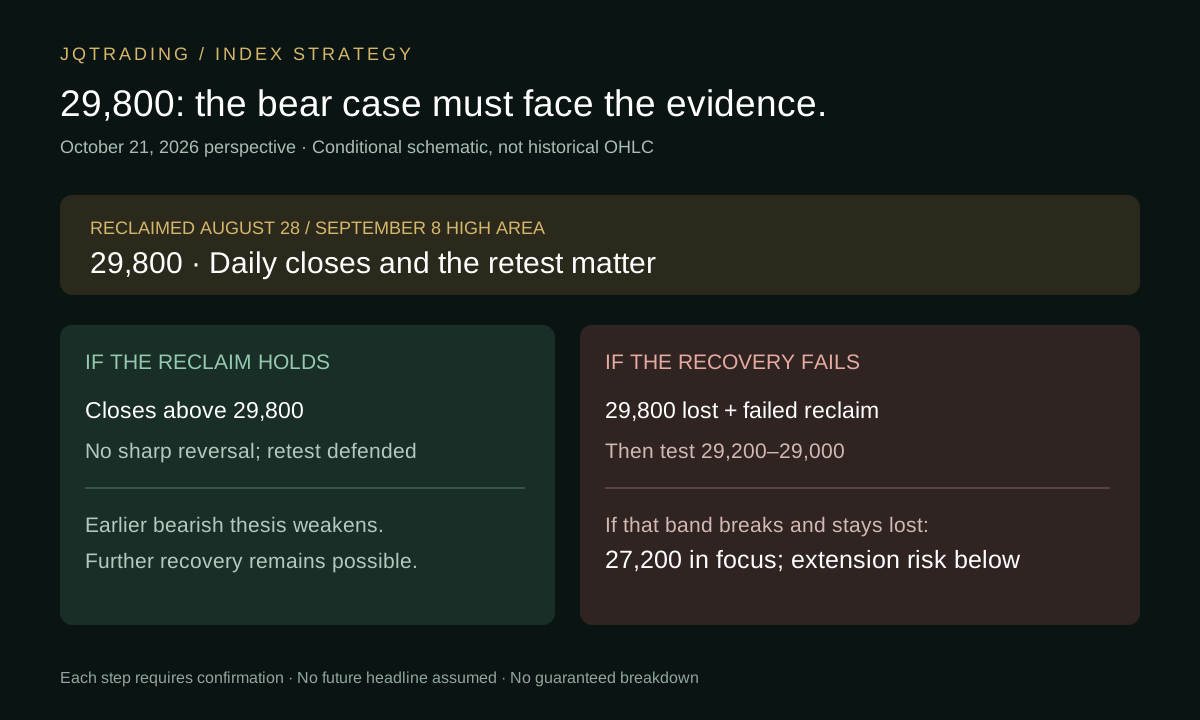
Repeated daily closes above 29,800, without an immediate sharp reversal, would support the recovery and weaken our earlier call. A rapid loss of that level would revive the downside concern. A subsequent break through 29,200–29,000 would provide stronger evidence of deterioration and shift attention toward the prior low near 27,200.
Revisiting October 14
We should revise the thesis when price challenges it.
In our October 14 closing-view report, we argued that losing the September 23 low raised the risk of a developing bearish structure. We looked toward the earlier consolidation base and favored a rebound followed by renewed weakness, while allowing for a more constructive outcome if a base broke higher and held.
The recovery above 29,800 matters because it challenges the expectation that the rebound would remain contained. It does not prove that a sustained uptrend has resumed, but it makes a large bearish continuation less convincing until sellers regain control. Our directional preference cannot take priority over that evidence.
We therefore separate two statements: we still lean bearish, but the major-downside scenario has not been confirmed by the latest reclaim. The next test is whether buyers can turn the recovered area into support.
The immediate test
29,800 must hold through the next sessions.
A constructive recovery should avoid repeated closes below 29,800 and should not immediately reverse in a sharp selloff. Several closes above the level, followed by a successful retest, would be better evidence of acceptance than an isolated move through resistance.
If that happens, our earlier bearish-regime thesis weakens further. We would need to allow for additional upside and reassess the relevance of a large downside target. Remaining skeptical is a personal stance; it is not a substitute for a failed reclaim on the chart.
If NQ instead falls quickly back below 29,800 and cannot recover it, the move would look more like a failed breakout. That would strengthen the October 14 warning. Even then, we would look for confirmation at the next support band rather than declare a major bear market from a single close.
The downside sequence
29,200–29,000 is the next confirmation band.
Our higher-conviction bearish scenario requires a sequence: the 29,800 reclaim fails, selling extends toward 29,200–29,000, and that band also gives way. Each step adds evidence. A loss of the first level does not mechanically guarantee a loss of the second.
If the market breaks below 29,000 and cannot reclaim the band, we would regard the recovery as materially damaged. Traders who bought the rebound could become trapped, stop orders may add to selling, and weaker liquidity could amplify the move. These mechanisms can make a decline sharper than the initial loss of support suggests.
In that scenario, the prior low near 27,200 becomes the next major reference. Our concern would extend beyond a simple retest: continued failure to stabilize could carry price below that low. We would treat 27,200 as a critical test, not a guaranteed floor. A decisive break and failed reclaim would support the case for further downside; a durable defense would challenge it.
Selling pressure and headlines
A negative feedback loop is a risk, not a predetermined event.
A failed recovery followed by a support breakdown can damage confidence. Position reduction, stop-driven selling and risk aversion may reinforce one another. Negative headlines, if they emerge, could intensify that response, while a falling market may become more sensitive to unfavorable information.
We cannot know in advance whether adverse news will appear, who would publish it, or how the market would react. No future headline is assumed here. Our bearish scenario rests on price losing support and failing to recover, with a possible feedback loop explaining how the decline could accelerate.
Our personal expectation is that a renewed breakdown would be substantial rather than shallow. That is a conditional forecast with strong directional conviction, not a statistical probability or a guarantee of a large selloff.
Scenario framework
Price must decide which interpretation survives.
| Scenario | Confirmation to watch | Implication for our view |
|---|---|---|
| Durable recovery | NQ holds daily closes above 29,800, avoids a sharp reversal and successfully retests the area. | The October 14 bearish-regime thesis weakens; allow for continued upside. |
| Failed reclaim | NQ falls below 29,800 and cannot recover it, but the lower support band still holds. | Bearish risk rises; a major decline remains unconfirmed. |
| Bearish continuation | 29,800 fails, followed by a sustained loss of 29,200–29,000 and an unsuccessful reclaim. | 27,200 becomes the next downside reference; a deeper extension is possible. |
| Prior-low failure | Price reaches 27,200, breaks below it and cannot regain it. | Evidence of a broader bearish structure strengthens; reassess the next support rather than assume a floor. |
Our stance
Cautious, but accountable to the reclaim.
As of October 21, we retain a bearish bias while acknowledging that the recovery above 29,800 is evidence against our earlier large-downside call. If the market holds that level, our view needs to change. If the recovery fails and 29,200–29,000 subsequently breaks, we would expect the downside scenario to become much more serious, with 27,200 and potentially lower levels in play.
We will update the research as the structure changes. The purpose of these levels is to make that reassessment explicit: conviction should be tested against what price does, rather than used to dismiss evidence that the forecast may be wrong.
Methodology
Technical framework and risk.
The August 28 and September 8 highs around 29,800, the 29,200–29,000 band and the prior low near 27,200 are analyst-supplied inputs. No independently verified OHLC series, exact October 21 closing value or numerical probability is asserted. Contract selection, roll adjustments and session boundaries must be consistent when applying the framework.
Related analysis: October 14: NQ Breaks the September Low. A developing bearish structure is not interchangeable with a confirmed conventional bear-market drawdown. These are conditional research judgments; futures involve leverage and substantial risk. This commentary is not individualized investment advice.